By Samuel Okposin
EKET, Nigeria – As global food supply chains face unprecedented pressure from climate change and economic volatility, the management of Agricultural Development Schemes (ADS) in Akwa Ibom State is undergoing a radical transformation. Moving away from the legacy of paper-based systems, a new era of data-driven, transparent management is taking root in Eket and surrounding local government areas to ensure that subsidies reach the soil.
Redefining Resource Allocation
For decades, the primary challenge of large-scale agricultural initiatives has not been a lack of funding, but rather the "leaky bucket" of distribution. Traditional management often struggled with "ghost farmers," diverted inputs, and a lack of real-time monitoring, leaving many genuine smallholders without support.
Today, local stakeholders are pivoting toward Integrated Management Systems (IMS).
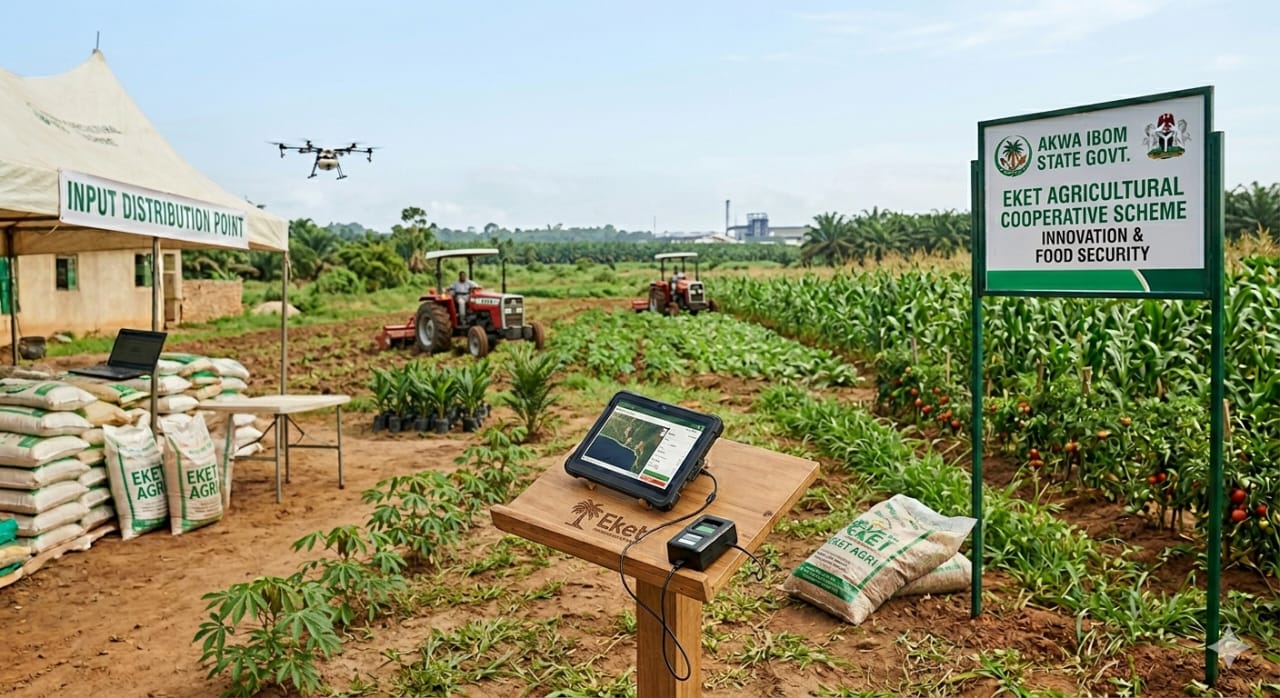
These digital platforms utilise satellite imagery and GPS mapping to verify land holdings before a single bag of fertilizer is dispatched to farms across the state.
"We are no longer just handing out seeds and hoping for the best," says Dr. Elena Vance, a senior consultant in rural development. "Effective management now requires a 'closed-loop' system where every input is tracked from the warehouse to the specific coordinates of a registered farm."
The Digital Backbone of Modern Agriculture
The shift toward digital transparency is characterised by three core pillars that have replaced the manual ledgers of the past:
Biometric Verification: To eliminate middleman interference, many schemes now require fingerprint or digital verification for farmers to claim their allocations. This ensures that the identity of the beneficiary matches the person receiving the goods.
Real-Time Analytics: Management dashboards now allow supervisors to monitor soil moisture levels and crop health across thousands of hectares in the Eket region. This enables proactive support, such as dispatching pest control before an outbreak spreads.
Direct-to-Farmer Payments: Mobile money integration has bypassed traditional banking hurdles and physical cash handling. This ensures that financial grants land directly in the digital wallets of those tilling the earth, reducing the risk of administrative "skimming."
Impact on Productivity and Efficiency
The results of these management overhauls are becoming visible in harvest yields. In regions where management schemes have adopted precision techniques, resource leakage—the loss of funds or materials to corruption and waste—has plummeted from an estimated 25% to less than 5%.
Furthermore, the speed of input delivery has been slashed from several weeks to just a few days, ensuring farmers receive supplies exactly when the planting window opens.
Challenges on the Horizon
Despite the technological leaps, human-centric challenges remain. Digital literacy among aging farmer populations and inconsistent internet connectivity in remote "last-mile" areas continue to be significant hurdles. Experts argue that the management of these schemes must remain as much about community engagement and education as it is about sophisticated software.
As the 2026 planting season approaches, the focus in Akwa Ibom remains clear: management is no longer just an administrative task—it is the vital bridge between policy intent and regional food security.